This project brings together my interest in amateur radio and the support of a friend in Arkansas City. He is providing the property and structure that will house the equipment, while I am leading the development and operation of the radio system under AC9WM.
The first phase would establish a UHF repeater for local conversations, with an AllStarLink connection opening the door to other repeaters and communities. A planned link to Chicago’s WM9W system would bring familiar voices, regular conversations, and scheduled nets to the Arkansas City airwaves—giving local operators people to talk with from the beginning.
A small web server would provide local amateur radio information. The site would be designed for remote management, with room to grow into AREDN data services, optional cameras, and a future 220 MHz repeater.
As the project takes shape and comes on the air, both of us hope it will gradually grow into something led and operated by the community it serves. We would welcome local operators bringing their ideas, experience, and enthusiasm, building friendships and taking an active role in the system’s future.
The UHF radio system
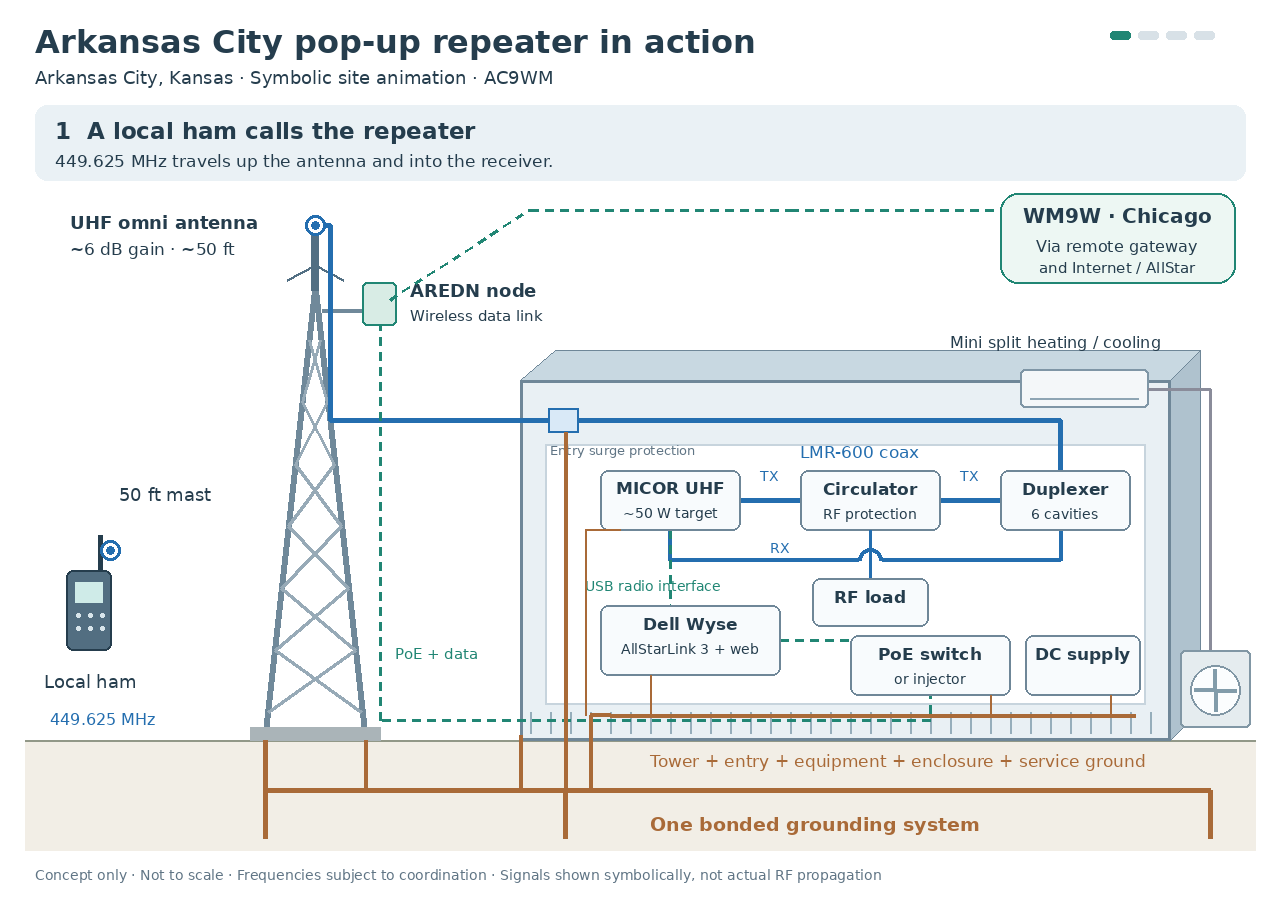
The planned radio is a Motorola MICOR UHF mobile rated at approximately 75 watts, initially adjusted to about 50 watts. It needs the appropriate frequency conversion, crystals, alignment, and full duplex repeater configuration. Fifty watts is a starting target: sustained transmit testing will determine the cooling and power level suitable for continuous service. Fans, temperature monitoring, and further power reduction may be needed. 3
The proposed frequency pair is 444.625 MHz transmit and 449.625 MHz receive, with a 114.8 Hz access tone, subject to Kansas frequency coordination and final approval. The antenna would be an omnidirectional UHF antenna with approximately 6 dB advertised gain, installed at about 50 feet above ground. The final antenna specification must identify whether that gain is dBi or dBd.
A six-cavity duplexer would allow the transmitter and receiver to share the antenna. It must be suitable for the chosen pair and aligned and tested for isolation and insertion loss. An additional notch filter is available if testing identifies a nearby interfering frequency. Its suitability will depend on the interference found.
The planned transmitter protection is a UHF circulator with a properly rated termination, forming an isolator that diverts reflected power into a load. LMR-600 coaxial feed line would connect the antenna to the radio equipment. The final installation also needs suitable jumpers, connectors, weather sealing, and surge protection.
AllStarLink and the computer
A Dell Wyse mini computer running AllStarLink 3 would handle repeater control and network voice linking through a compatible radio interface. I plan to add monitoring and automatic recovery software to restart failed services and restore intended links. A transmitter timeout and an independent shutdown method are also needed; software recovery alone cannot resolve every fault.
Networking and Property Requirements
AREDN and local information services
An AREDN node would provide amateur-radio data networking to another reachable node. If that remote site provides a suitable Internet gateway, the link could carry the repeater’s AllStar traffic. AREDN does not supply Internet access by itself: we need a working remote endpoint and a usable radio path, or a separate Internet connection in Arkansas City.
The network would include a PoE switch or suitable injectors to power the outdoor node. The switch must support the node’s actual voltage and passive PoE requirements; ordinary camera PoE equipment is not automatically compatible. 2 A direct AREDN path to Winfield will require a separate line-of-sight and obstruction check, including clearance around the radio path.
The Dell could also host a lightweight local website. A public copy could be available through the Internet, while locally hosted information and mesh services could remain accessible across a functioning AREDN network during an Internet outage. These services still depend on power and working local links. Useful examples include: 1
- Local repeater frequencies, access tones, net schedules, club contacts, and operating instructions.
- A repeater status page, outage notices, maintenance updates, and station activity information.
- Mesh-accessible chat, downloadable documents and forms, event information, weather observations, and optional VoIP phones or camera images. Each service requires its own software and configuration.
Cameras are optional. We could add a local camera network or periodically refreshed still images on the website, similar to the approach used in Chicago. Still images would reduce bandwidth needs. Public views would be chosen with the property owner. Traffic sent over amateur RF must be configured for permitted amateur use; private or encrypted services should use an appropriate separate network. 4
Space climate control and electrical service
We need a secure, weather-resistant equipment shelter with space for the radio, duplexer, computer, power supply, and networking equipment. A small ductless mini split heat pump—the Japanese style heating and cooling unit we discussed—would control temperature.
A dedicated 120-volt, 20-amp circuit is the proposed starting point for the equipment. Its nominal capacity is 2,400 watts, but that is not a continuous operating budget. The final circuit arrangement must be checked against the selected HVAC unit’s voltage, nameplate load, and required circuit, plus the radio power supply and other equipment. The HVAC unit may need a separate circuit. We should also plan for power recovery after an outage and decide whether battery or UPS backup is wanted.
Coverage and Future Expansion
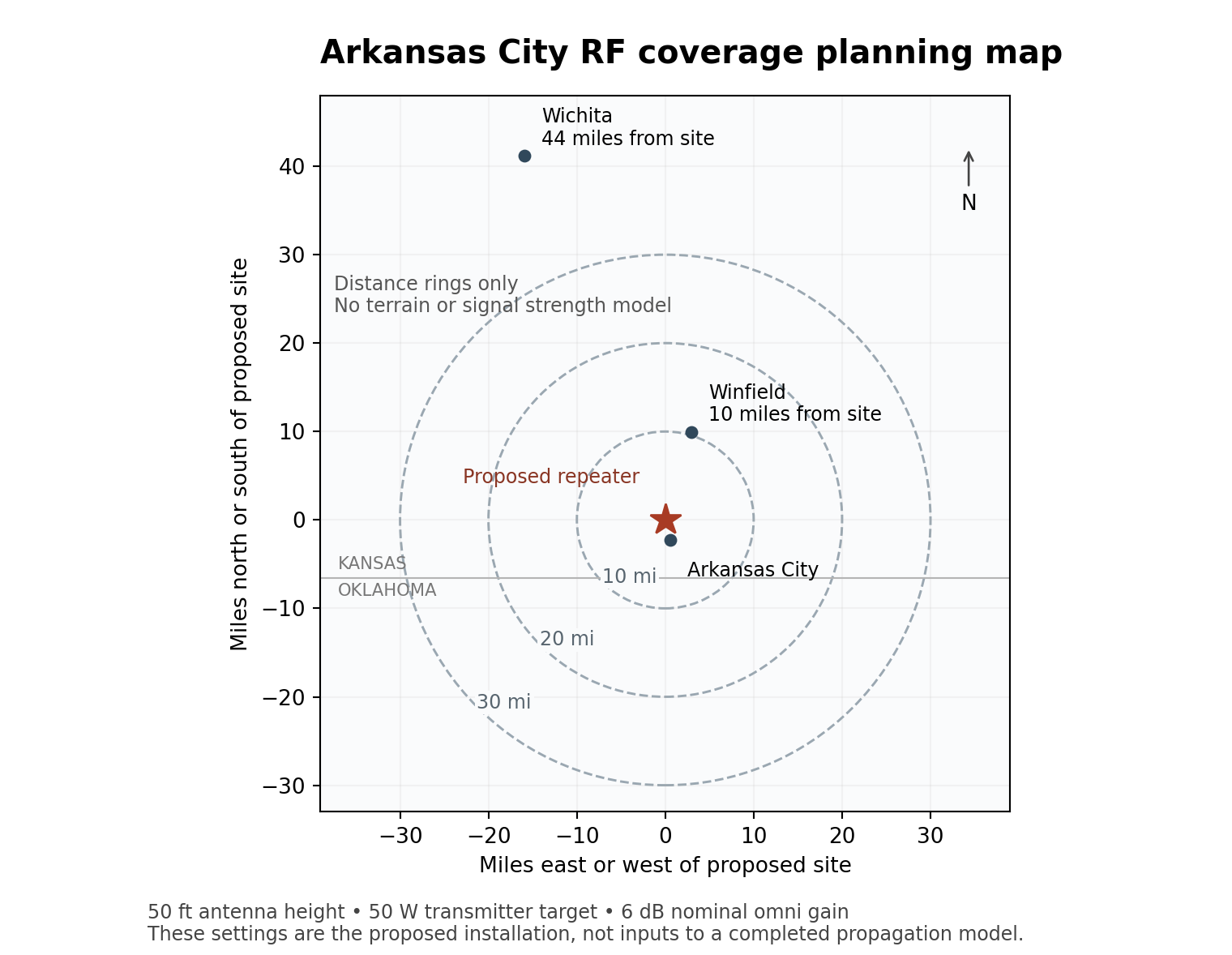
Map note: This is a geographic planning map, not a terrain-modeled RF coverage prediction. The rings show distance only. The star marks the proposed repeater location, and town markers are approximate town centers. Buildings, trees, terrain, interference, antenna patterns, feed-line loss, and user equipment are not modeled. 6
What we can reasonably plan to test
The property is believed to be on favorable high ground in the Arkansas City area. That is encouraging, but its elevation relative to nearby terrain has not yet been verified here. A proper coverage study needs the actual mast location, terrain elevations, antenna model and gain reference, installed losses, receiver performance, and defined handheld, mobile, or base-station assumptions.
A 220 MHz system is also being explored. A 220 duplexer has already been acquired, and test equipment for converting and aligning suitable radios is being acquired. The lower frequency may improve some paths, but better coverage depends on the complete installation and cannot be assumed from frequency alone.
Additional suitable sites could extend linked service from Arkansas City through Winfield toward Wichita. Wichita’s center is roughly 44 miles from this property; regional coverage should be treated as a network expansion goal rather than an established capability of this initial 50-foot site.
Remaining Work and Installation Decisions
The principal remaining RF purchases are the feed line, antenna, and radio power supply. The property work includes the equipment shelter, heating and cooling, electrical service, and the 50-foot mast. The following separates those known needs from parts and work that still need confirmation.
| Item | Current position |
|---|---|
| LMR-600 feed line and UHF omni antenna | Needed; confirm cable route, total length, antenna model, and gain reference. |
| Radio DC power supply | Needed; size for measured transmitter current, continuous operation, and cooling loads. |
| Shelter HVAC and mast | Needed; shelter, heating and cooling equipment, and the mast. |
| MICOR six-cavity UHF duplexer notch filter and circulator | Planned system components; verify possession, model suitability, tuning, and load ratings. |
| Dell Wyse AREDN node and PoE equipment | Planned; confirm hardware on hand, radio interface, compatible power, and remote link endpoint. |
| 220 duplexer and radio development | Duplexer acquired; radios are being explored and bench equipment is being acquired. |
| Small installation parts and protection | Confirm jumpers, interface cable, DC fuses, fans, grounding and bonding, coax and Ethernet surge protection, and weather sealing. |
Commissioning
Before unattended operation, I will need to finish frequency coordination, radio conversion and alignment, verify duplex isolation and receiver performance while transmitting, run sustained thermal tests, and verify station identification, timeout, remote shutdown, and recovery after a power or network failure. The installation also needs an RF exposure assessment, appropriate grounding, and a mast foundation and guying arrangement matched to the structure and wind load. 3, 5
References and map notes
- AREDN Services Overview
- AREDN Power over Ethernet
- Repeater Builder — MICOR UHF mobile; repeater installation checklist
- FCC amateur transmission rules
- ARRL RF exposure guidance and calculator
- Map notes: Approximate town coordinates from Kansas Hometown Locator and the federal community coordinate listing in 47 CFR 76.53. Local distance projection; no terrain dataset was used.